

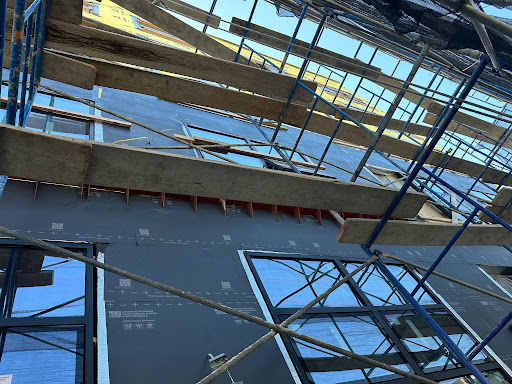
Modern buildings are expected to do far more than provide shelter. Today’s commercial and residential structures must deliver long-term durability, energy efficiency, indoor comfort and protection against moisture-related failures. That places enormous pressure on the building envelope — the barrier system that separates indoor environments from outdoor conditions.
When moisture infiltrates a building envelope or becomes trapped within wall and roof assemblies, the consequences are well documented: structural deterioration, mold growth, insulation failure and a measurable decline in energy performance.
As a result, architects, consultants and OEMs are increasingly scrutinizing the performance of every component within the envelope system, and none more so than the air barrier.
Common Moisture Problems in Building Envelopes
Moisture problems rarely begin with obvious leaks. In many cases, damage develops gradually inside walls, roofing systems or insulation layers long before it becomes visible. Effective moisture control starts with understanding the most common issues affecting modern building envelopes.
Condensation in Walls and Roofs
Condensation occurs when warm, moisture-laden air meets cooler surfaces inside wall or roof cavities. As temperatures drop below the dew point, water vapor turns into liquid moisture. Over time, trapped condensation can saturate insulation, damage framing materials and compromise structural integrity.
This problem becomes even more significant in tightly sealed, energy-efficient buildings where airflow is intentionally minimized. Without a breathable membrane that allows vapor to escape, moisture can accumulate within the assembly.
BreathTech® membranes are engineered to deliver vapor permeability greater than 150 perms, in accordance with ASTM E96-B testing, while maintaining extremely high water resistance greater than 1000cm, in accordance with AATCC-127.
That balance is critical for maintaining a dry and functional building envelope.
Mold and Mildew Growth
Excess moisture trapped within building materials creates the ideal environment for mold and mildew growth. Mold can spread behind cladding systems, beneath roofing assemblies and inside insulation layers without immediate detection. Once biological contamination begins, remediation can become costly and disruptive.
High-performance vapor-permeable membranes help assemblies dry more efficiently, lowering the risk of persistent dampness that can turn to microbial growth.
BreathTech® uses a specialized sub-micron pore structure that promotes vapor transfer while limiting water penetration. This allows moisture within the assembly to escape before it accumulates to damaging levels.
Why BreathTech® Membranes Are Preferred
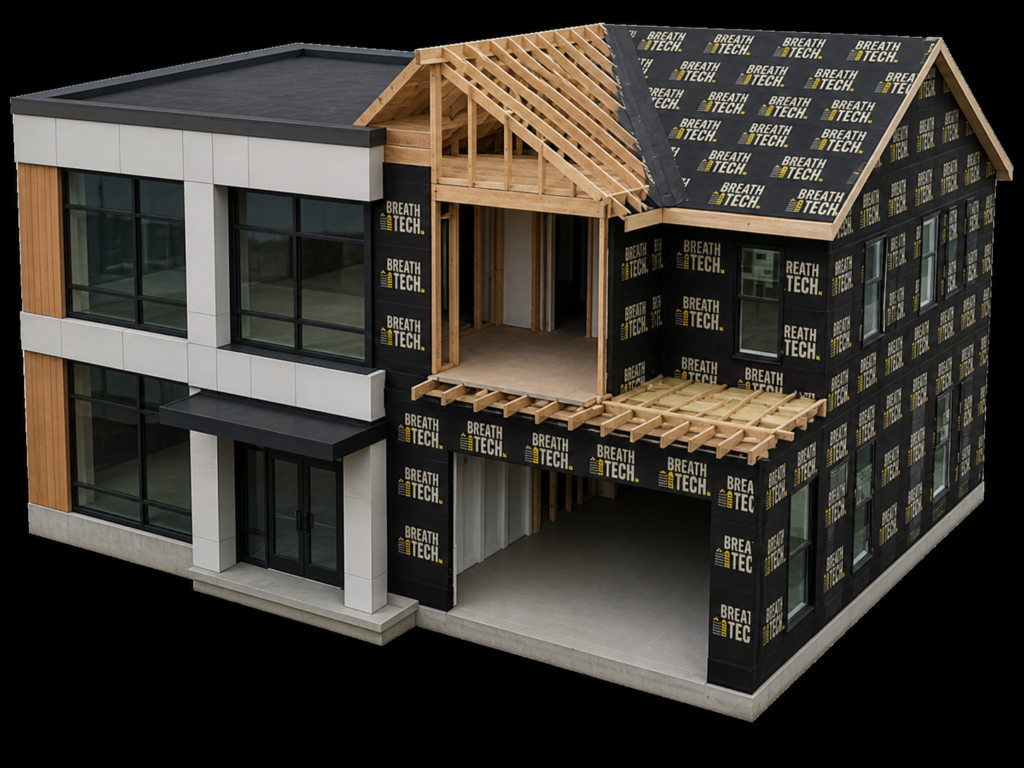
Not all breathable membrane technologies perform the same way. Material composition, pore structure, durability and manufacturing quality all influence long-term moisture-control performance.
BreathTech® has gained attention among consultants and OEMs because its technology addresses several limitations commonly associated with conventional membrane systems.
Monolithic Microporous Design vs. Tri-Layer Membranes
Many traditional building wrap products rely on tri-layer membrane constructions that combine thin films with nonwoven materials. While these systems may initially perform well, consultants often express concerns about long-term durability, pore blockage and membrane degradation.
BreathTech® utilizes a proprietary microporous membrane structure developed through decades of membrane manufacturing expertise. The company’s production process was originally developed for highly engineered battery separator technology, where precision and consistency are critical.
Instead of fragile layers, BreathTech® membranes are designed with a robust polymer chain structure and a highly uniform sub-micron pore network. This design helps maintain consistent moisture control and superior durability for the long term.
High Vapor Permeability for Moisture Control
One of the most important functions of a breathable membrane is allowing water vapor to escape from the building assembly. If vapor becomes trapped, moisture can eventually damage surrounding materials.
Scientific research on breathable membranes shows that microporous structures can allow water vapor molecules to pass through while preventing larger water droplets from penetrating the material.
BreathTech® membranes are engineered specifically for this type of performance. With vapor permeability values above 150 perms, rapid drying is supported within wall and roof assemblies.
Ultra High Water Holdout for Moisture Control
Along with high vapor permeability, the membrane maintains high hydrostatic resistance against bulk water intrusion. During construction and beyond, the air barrier must prevent heavy rains, heavy leaks or other bulk water intrusions from entering the structure. When put to the dynamic hydro head test, AATCC- 127, BreathTech achieves 1000cm + of water pressure before failure. Unlike typical tri-layer membranes, whose failures occur at far lower water pressures with 3 droplets of water seeping through, the BreathTech failure mode is a bursting sheet. BreathTech has high water holdout, but perhaps more importantly, a level of durability that is difficult to match.
The combination of high water holdout and high permeability gives consultants greater confidence when specifying materials for demanding building envelope applications where both breathability and water holdout are required.
Proven Durability and R&D Expertise
Durability remains one of the most important considerations in building envelope design. Membranes may face prolonged UV exposure, fluctuating temperatures, wind-driven rain and demanding jobsite conditions before the building is fully enclosed.
BreathTech® emphasizes long-term performance through its robust material composition and manufacturing expertise. The membrane maintains performance properties even after extended UV exposure, with testing up to 5,000 hours showing no significant degradation in water penetration resistance.
The technology is backed by Daramic’s decades of membrane manufacturing experience, multiple global technology centers and extensive expertise in polymer chemistry and microstructure analysis.
For consultants and OEMs, that level of technical support and R&D capability adds another layer of confidence during specification and product selection.
Key Considerations for Consultants and OEMs
Selecting the right breathable membrane requires more than comparing product datasheets. Consultants and OEMs must evaluate how the material performs within the full building envelope system.
Several factors typically influence specification decisions:
- Vapor permeability and drying potential
- Resistance to bulk water intrusion
- UV stability during construction exposure
- Compatibility with coatings, adhesives and laminates
- Installation durability
- Long-term performance consistency
BreathTech® membranes are designed to support a wide range of applications, including roofing membranes, mechanically fastened building wraps, self-adhered wraps, sheathing systems and integrated rainscreen assemblies.
The membrane’s bondable structure also allows integration into multilayer construction products and coated systems without sacrificing breathability.
For OEMs developing next-generation building envelope systems, that flexibility can support both performance goals and manufacturing efficiency.
The Future of Moisture Control Starts Here
As building standards evolve and performance expectations rise, the breathable membrane has never mattered more. BreathTech® meets that moment, combining high vapor permeability, strong water resistance, advanced microporous design and proven durability in a single-membrane solution built for real-world conditions.
Build envelopes that last. Discover BreathTech® vapor permeable membrane technology and request your technical information today at breathtechfilm.com.